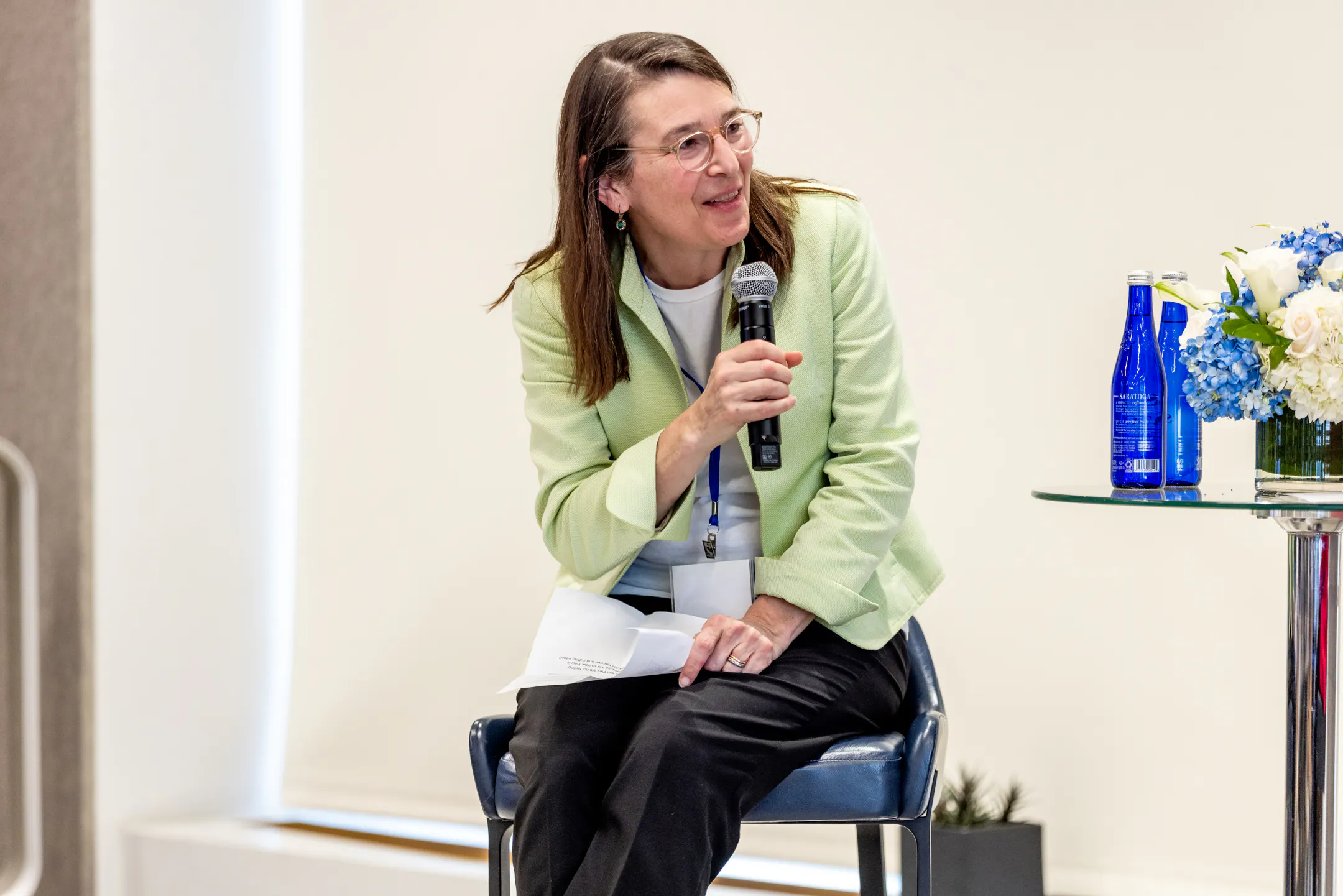
In this edition of the Life@FT blog, we speak to Brooke Masters, US Managing Editor at the Financial Times. From local reporting in Virginia to covering white-collar crime in New York and later leading teams across the FT, Brooke reflects on a career shaped by curiosity, adaptability and a willingness to embrace unexpected opportunities. She also shares what working across the US and UK has taught her about communication, leadership and building a sustainable career in journalism.
Tell us a little about your path into journalism. Did you always know this was what you wanted to do?
I was always very drawn to journalism. I did hardcore college journalism — my student paper came out six days a week, and I spent most of my time there. But I definitely didn’t set out to become a business journalist.
I started at The Washington Post, covering local government in Virginia, and then moved into higher education, crime, justice and legal reporting. I came up through local news, which gave me a really strong grounding in dealing with real people rather than flacks. It was only later, in 2002, when Enron had gone bust and other big corporate scandals were unfolding, that I moved into business journalism and started covering Wall Street and white-collar crime in New York.
Learning a new beat
What was the biggest challenge in moving into business reporting?
The hardest part was that I’d never taken an economics course. I had to learn how to read balance sheets from scratch.
Covering legal cases in business was a relatively natural transition for me, but learning how finance worked — how companies made money, how markets reacted to results — was much harder. I often say that when I first started out, I knew more about how to fake a balance sheet than how to interpret a legitimate one. Over time, though, I learned that not understanding something straight away doesn’t mean you can’t grow into it.
Joining the FT
What drew you to the FT?
There were two big reasons. The first was that my husband’s career is international, so I needed to know that if life took us abroad, the FT would support that. The second was flexibility.
At the time, I was working four days a week because I had young children. I’d spoken to other organisations, and the response was often: “Come back when you want to work five days a week.” The FT was the first place that said, “Four days a week — we can make that work.” That made a huge difference to me, and it’s something I’ve always valued.
Flexibility and career progression
How important was that flexibility in helping you build your career?
It was incredibly important. I worked four days a week for around 14 years, and I was able to continue doing meaningful, ambitious work while raising my children.
At the time I first made that choice, it wasn’t especially common to do that on a hard news beat. I had to prove it could work. But it did work, and I stayed on that pattern until much later in my career when I became companies editor.
A defining FT role
Was there a particular role at the FT that felt especially formative?
One of my favourite roles was being chief regulation correspondent in the aftermath of the financial crisis. It was a fantastic time to be covering regulation, banking reform and white-collar crime because the work felt central to what was happening in the world.
It brought together so many of the things I enjoy most: legal reporting, accountability, finance and big global stories. It was also the point where my expertise and the news agenda aligned most clearly, and I stayed in that role for longer than almost any other.
Moving into leadership
How did the transition from reporting into editing and management feel?
Running a desk was a very different experience. It was more full-on in some ways, but it also gave me the chance to shape coverage more broadly — deciding where we should focus, making sure the right reporters were on the right stories and commissioning ideas I thought were interesting.
I was lucky to have support from colleagues along the way. Patrick Jenkins (now Deputy Editor of the FT), in particular, was a really important mentor. He gave me space to talk through frustrations and think about what to do next, which was invaluable because managing is rarely straightforward. A lot of it is about people, and people problems don’t come with easy answers.
Working across cultures
You’ve worked in both New York and London. What have those experiences taught you?
Working across both offices has taught me a lot about communication and culture. London is the mothership — it’s where a lot of decisions happen, and it sits at the centre of the time zones. In the US, we’re a big operation, but we’re still an outpost in that sense.
That means you have to be very good at asynchronous communication: leaving clear information for colleagues in other regions, and making sure people have what they need before you sign off. It also teaches you to be thoughtful about tone. I’m American and naturally quite direct, and I’ve had to learn how to communicate in a more international organisation where not everyone interprets bluntness in the same way. At the same time, I’ve learned the value of being more direct and, in the end, saying, “This is what I meant. Do you understand?” because something that feels perfectly clear to me is not always clear to someone else.
Fostering collaboration across the newsroom
As US Managing Editor, how do you make sure your teams stay connected with each other and with colleagues globally?
A lot of it comes down to encouraging people to keep talking to each other — and not just by email. I often encourage colleagues to pick up the phone or have a proper conversation instead of relying on typed messages, because tone can get lost very easily. In the New York newsroom, we instituted wine and cheese on Thursday evenings to give people a social reason to come together.
One of the great strengths of the FT is that we have colleagues all over the world. If a story crosses borders, there is almost always someone somewhere in the newsroom who can help. That global network is a huge advantage, and part of the role is making sure people use it well.
Switching off in a demanding job
Journalism can be intense. How do you recharge?
I’m a big believer in taking your holiday and finding ways to switch off properly. For me, that often means reading historical romance novels — particularly the really goofy ones from the Regency era — doing crosswords, and getting outside with the dog.
I think it’s really important to have something that takes you mentally away from work, whether that’s during the week or on holiday. In a job where communication never really stops, you need to find those moments of refuge deliberately.
Advice for future journalists
What advice would you give to someone starting out in journalism today?
Don’t get too hung up on exactly what you think you want to do. Be open to opportunities, try things, and don’t assume that the career you imagined at 21 is the one you have to follow exactly.
I’d also say: don’t focus too much on titles or reporting lines. Your impact comes from who you are, the quality of your work, and how helpful and collaborative you are with other people. Especially in journalism, doing really good work matters far more than having the perfect title at the perfect moment.
BUILD A NEWSWORTHY CAREER AT THE FT. FIND YOUR NEXT ROLE WITH US.